As Thompson once wrote, "There he goes. One of God's own prototypes. A high-powered mutant of some kind never even considered for mass production. Too weird to live, and too rare to die."
Selah.
So it goes.


Just as a quick follow-up to that last post (check that one out first if you haven’t):
Whenever someone asks me, “How many times have you seen Pearl Jam?” and I reply, “Oh, somewhere in the 20s,” and they say, “My lord, Pearl Jam has come around here 20 times?” and I reply, “No, I’ve seen them in a variety of different cities,” and they say, incredulous, “You take trips to see a band you’ve seen 20 times already?” when I say, “Yes,” always, without fail, I get that look. It’s the same look as when someone asks, “You paid how much for that first edition Hemingway?” or, not believing the seemingly impossible words I’ve just uttered, “You don’t eat French fries?” It’s a look not far from disgust; it’s a look, at the very least, of admonishment, as if I were a child and I’d done something so stupid, so beyond belief, that it seems impossible even a child would do it, let alone an adult. A grown man. It’s a look that immediately reminds you of your parents. It’s a look you never thought you’d have to see again, now, being an adult; now, you make your parents proud; that look, you’d hoped, was a thing of the past.
So, look, here it is: “I’m going to see Pearl Jam next week. Four times. In one week.”
If I meet you on the street and you ask me why, what I’ll tell you is this: “Every night they put on a new show. They’re not like other bands, who just repeat the same set list over and over again night after night; Pearl Jam doesn’t just change the order, they change the whole set. There’s a different energy and different song selection. It’s not really the same show like you imagine.”
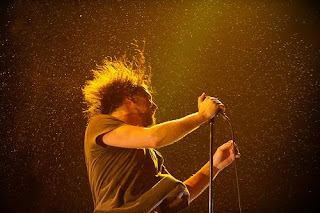
While all of that is true, you can tell I’m being defensive (and dry) in my response to the You I encounter on the street; the reason: how can I possibly, in mere minutes on the side of the road, explain to that twisted look of ridicule and derision that no matter how many times I see Pearl Jam, I will never tire of the feeling(s) the experience produces, I will never tire of running into fellow fans outside the venue who, when I ask where’s a good place to get food (because, I say, I’m not from around here), they say, hang on a minute, we’ll take you to our favorite place, we can grab something together; I’ll never tire of spending an entire day sitting outside a ticket booth with seven other strangers, who, in a mere matter of hours, become friends for the long haul, friends who, when I’m later in jeopardy of missing the show for which we’ve been waiting around all day, risk missing the show themselves in order to get me in, and later offer lodging when I explain I have a very long drive home; I’ll never tire of the immediate trust when I offer to sell something to someone online, someone I’ve never met before, never spoken to before, and I say, “How do you want to work this?” and they say, “I’ll just send you the money, you’re a Jammer, it’s all good.”
I will never tire of having a family.
Because if the one thing we want most is to live forever, the second thing we want is for our family to live forever, too. And more than just escape, more than simply shutting out the aforementioned insidious voice, the music allows this Ponce de Leon dream, this Frankenstein intrigue, to become reality. From the creativity of five individuals, from the sounds of string and drums and wood, something greater is composed: a whole.
I do want to live forever. We all do. But as much as that is true, I can’t imagine Forever without Family, without the whole. And while my sister is around the same age as me, my parents are beginning to get old, and gradually, with each passing year, the inevitable begins to stare you in the face just a little more clearly. The clock ticks louder. The voice gets louder. In all likelihood, barring a Kurzweillian cure, I will one day have to face that day, the one that will be worse than anything I can even begin to imagine. And while nothing—nothing—will ever begin to fill that hole, on that day, at least I’ll know this:
With the Jam, I’ll always have a family.

Sports saved my life.
Coming on the heels of C.’s earlier comments, some may think that I’m making light, trying to be funny, but I’m not. I’m serious.
Sports saved my life.
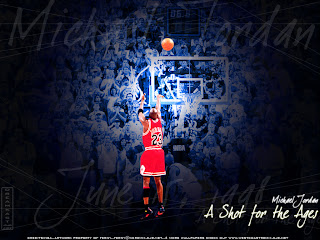
Clearly the above statement, like an overstuffed suitcase strapped together with buckling belts, requires some unpacking, during which time you will note that the original statement is a gross oversimplification, which neglects other equally oversimplified statements of veracity such as “music saved my life” and “books saved my life” and “Camus saved my life” and “writing saved my life.”
Sports saved my life is not meant to be all-inclusive, but rather it is intended to give a taste, a sense, of the way in which forks and spoons and baseball bats and book jackets can make all the difference in the world, and, in fact, can be the world.
Daniel Gilbert got it right in his book, Stumbling Upon Happiness: we don’t know what we want, what will make us “happy,” and what we think we want, what we think will make us happy, we’re often wrong about. It’s not that guy you’ve been secretly pining over for seven years, it’s not the white picket fence and the kids and the two-car garage, and it’s not that trip to Paris or Peru, though all of those things might make you “happy,” they won’t bring you Happiness.
While I may be departing from Gilbert’s theory at this point, for me, sports are an example of what does make me happy. Fantasy football makes me happy, cooking with (or for) a friend makes me happy, writing makes me happy, and Pearl Jam makes me happy. It’s no coincidence Hunter S. Thompson’s suicide note, if one wants to call it such, was titled: “Football Season is Over.” For Hunter, the symbol of the end was not some grand concept, some abstraction, but plain and simple football.
Why? Because football and cooking and listening to Pearl Jam are all distractions; they are ways of temporarily tuning out the voice that says, “You are going to die.” And the reason that voice is so pointedly insidious is that it makes you ask, “Why?” And no matter how much you twist and turn that lump of gray matter, you’re not going to come up with an adequate answer to that, the granddaddy of all questions. There is no answer (other than the obvious).
So, in order to avoid going the Heming Way, we let sports give us a distraction, a moment to shut the mind off, to block out the ever-present voice, to just be, and to be a part of something, a community, a where-were-you-when (fill in the blank), which, not coincidentally, is why that most famous question still gets asked by people of a certain generation: where were you when Kennedy was killed? And no one thinks of RFK or Jr. or anyone else, they know, and this question, if they have an answer to it, and in telling that answer, it makes them part of something indelible, part of something that will not die, something that the insidious voice cannot get to, cannot take away. And that’s all we really want: to live forever. To not be forgotten.
That’s why writers want to have been a part of Paris in the ’20s or ’50s, that’s why grandpa tells the same stories over and over again, that’s why basketball fans of my age talk about Michael Jordan as a god: we’re telling the voice, ha, I’ve beaten you, you can’t take this away from me, and even when you take me away, this will remain, and with it, I will remain.
For me, sports were the first to do it, to give me the upper hand, to make me a part of something at the primal level so satisfying that I didn’t even know it. Writing followed and cooking and collecting books, and a select handful of other things that touch a spot not quite discernable on the surface.
And when I’m old and gray, sitting in my rocking chair (and I do mean rocking), I’ll tell the grandkids, for the twentieth time, how when I was young—because when I’m old, I’ll look back at this time now as when I was young, even though now I already feel old—I’ll tell them, I used to go see this band called Pearl Jam, and the kids will look at each other and sigh, and I’ll look at each of those concert posters on the wall, each from a different show I saw, and I’ll know that each of those moments is forever, that my grandkids can listen to the CDs if they want, they can hear what that very night sounded like, they can look at my photographs, and nothing, no voice can take that away. That will remain. That is forever.
That will not die.

When I was really young, my mother had to sit with me at night until I fell asleep and then quietly sneak out of the room, because if I woke up, or if she went to sleep before I did, I wouldn’t sleep at all. As I got a little older, to stave off the nighttime willies, I watched M*A*S*H. reruns for hours on end, until the local TV stations stopped broadcasting, and then I would turn to one of those stations, which likely don’t even exist anymore since the advent of cable, that had some seedy spokesman hawking some foundation or some product, which I vaguely associate with religious hymns and bald eagles for some reason that is no longer clear to me; around five or six in the morning, the regular TV stations would come back on air and it was usually about this time that I would actually fall asleep.
I suppose all of this was a sort of sad and telling state of affairs for an eleven-year-old boy, but I was only vaguely aware that something was off, in the same way that one can feel watched, look up, see no one there, and return to whatever it is that they were doing; the oddity, in my mind, was only something vaguely recognizable, something I figured everyone encountered, something not too far outside the norm, and thus something that, as ruminations go, could be brushed off as not worthy of deep consideration: it just was.
Although it was by no means clear to me at the time, looking back it is not hard to see that I obtained an obsession as a result of my insomniac nights. On the school bus one morning, I overheard one kid telling another that his father couldn’t leave the house in the morning without two cups of coffee. “He can’t face the day awake without it,” the boy said. Why an eleven-year-old would be discussing his familial coffee habits on the school bus, I don’t know, but the words stuck with me and I planned my strategy for the next morning.
.jpg)
“Mom, can I have some coffee?”
“Why?” She didn’t even turn from the countertop to look at me.
She wasn’t buying it.
“It smells good,” I said, “and I tasted Dad’s and it tasted good.”
“Get a cup,” she said, still not turning from the lunch she was preparing.
It had worked. I got my coffee that morning, my first cup of steaming black brewed coffee, which also seemed to me the marker of being an adult, and though, like so many things, I can no longer remember what my initial impression was, eighteen years later I can’t live without the stuff, despite the fact that more often than not it terribly upsets my stomach, despite the fact that my gastroenterologist has advised me to avoid it, despite the fact that, for me, it is a very expensive habit (because I have another obsession, and that is having only the finest of everything, but that’s a whole different sport, and we can play that one some other time, perhaps).
So, for a while, coffee got me through my days and kept me awake for my sleepless encounters with M*A*S*H and the seedy spokesman. While I’d always seen random electronics parts in the basement of our house, circuit boards and such, it wasn’t until the age of twelve that I encountered my first police radio, a gadget I believe my father had put together many years earlier (I’d eventually recognize the soldering as evidence of his handiwork). Unfortunately, he told me that it didn’t work, something about crystals being too old, which really piqued my curiosity: there were crystals in a police radio?
I suppose I forgot about the thing, though, because it wasn’t until Irv, a friend of the family, presented me with one of his old, barely functioning police radios that I actually got to hear one of the things in action. The radio consisted of a black rectangle the size of a school lunch box, but several times heavier, with lots of little knobs and a pullout antennae. When turned on, it sounded like an angry brood of cicadas that had indeed been sleeping for seventeen years, brooding the whole time and only now letting the world know about it. But something magical happened that first night as I curled on the floor in my bedroom, turning the knobs, adjusting the tin foil I’d attached to the antennae: I fell asleep.
And so began my fascination with police scanners, which, I later learned, my uncle also used to help fall asleep at night; I realized this when, shortly after that first night in my bedroom, I saw a similar device on top of my uncle’s dresser, just out of reach, and asked him about it, his answer providing confirmation that my situation, like that sense of being stared at, was not so unusual.
For many years, I lugged a slowly improving set of police scanners and overly large antennae with me from house to house and apartment to apartment; I had one in my college dormitory and one in my post-grad apartment, but when I made my most recent move, I took the still-space-consuming scanner back to my parents’ basement where it currently resides. I just didn’t have the room in my new place and the reception was pretty poor anyway.
You can imagine my excitement, then, when I found out earlier this week that my new phone has a police scanner built into it, and, to my great surprise, one that works far, far better than any of the hefty clunkers that came before it. Gone are the angry cicadas and fiddling of knobs, present is a crisp, clear signal with easily discernable and intelligible voices. Present is my choice of counties and states to eavesdrop on and a list of their most oft-used codes. Present is a portability never before imagined.
Perhaps, then, it is no surprise that I have been listening to the thing nonstop. When I wake up in the morning and prepare breakfast, when I drive to work, when I’m sitting in my office, when I’m grading papers, when I’m driving home, and when, as the whole thing began, I’m going to sleep. And there’s the rub: most of the time, I do sleep now.
So what was it, what is it, about the police radio that worked where such powerhouses as M*A*S*H and the seedy spokesman had failed? Certainly I had no clue at the time, and I can only speculate now, that it had something to do with quelling the sense of dread surrounding the thought that everyone around me was tuning out, falling prey to that netherworld of suspended animation, willingly giving in to the haze that awaits all of us at the end of the road, but that I couldn’t see allowing in so early. The scanner provided some kind of confirmation that, yes, you can close your eyes and we, the voices not of some far off land—as I used to try to assure myself with—but of Randolph Road and Briggs Chaney and 198 right down the street, will be here to keep the world turning while you rest. There was, and is, some solace in knowing that the roads are still roamed and activity still takes place, even at three and four in the morning, that there is a baker beginning his day beneath a single bulb, that a coffee pot is being put on, that a club owner is just shuttering his doors. I could close my eyes at night, let their voices lull me to sleep, and wake up in the morning with them still sitting on my nightstand. They wouldn’t abandon me; they would be there.
They are here still.